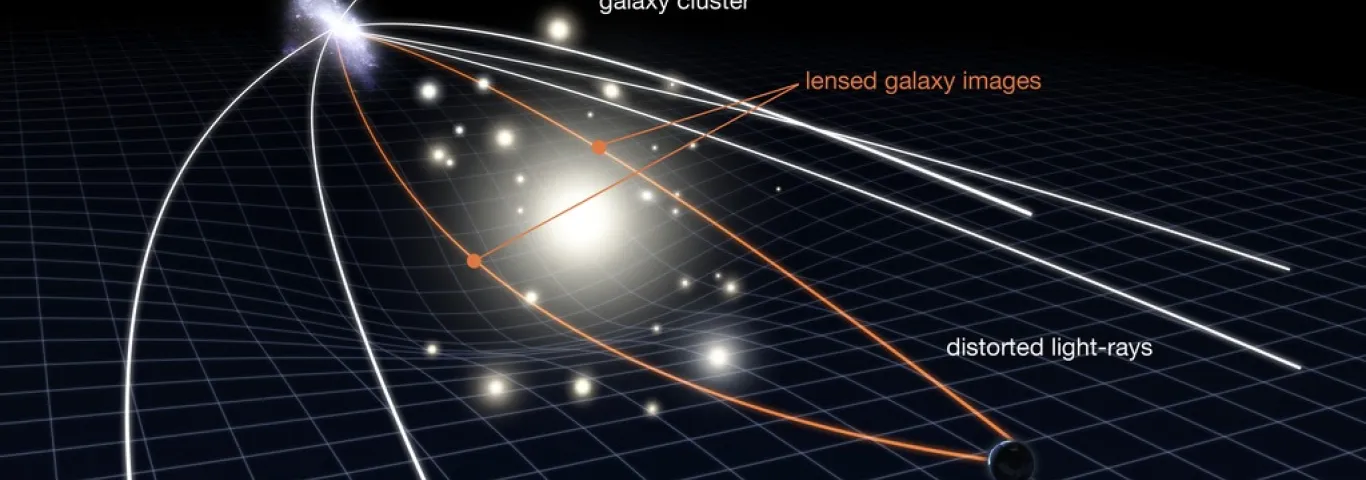
Some of the universe's most powerful telescopes are created by nature itself. They are massive galaxies whose gravity bends and magnifies light from galaxies lying far behind them, creating what astronomers call strong gravitational lensing.
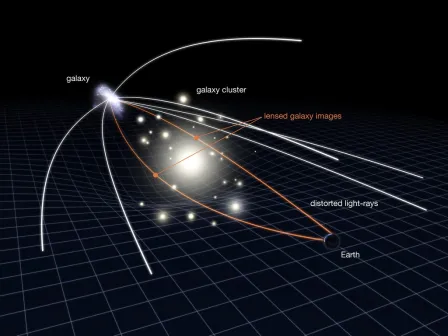
A newly selected Roman Cycle 1 General Investigator program involving WashU researchers will help prepare astronomers for the telescope's first observations, building on and extending the work done as part of the Wide Field Science (WFS) program led by Tansu Daylan, assistant professor of physics at WashU and an MCSS fellow.
To prepare astronomers for Roman's anticipated flood of imaging data on gravitational lenses, the team has been organizing a community-wide data challenge as part of the WFS program. Using accurately simulated Roman observations generated by the team’s mejiro pipeline, researchers around the world can test and refine the algorithms used to identify and analyze gravitational lenses. The challenge will help ensure astronomers are ready to make the most of Roman's observations from the first day of the mission.
One of the main results from the WFS program has been that NASA’s Nancy Grace Roman Space Telescope is expected to discover more than 100,000 strong gravitational lenses, far more than astronomers have ever studied before. Strong gravitational lenses allow astronomers to map invisible dark matter, measure the expansion of the universe, and study distant galaxies that would otherwise be difficult or impossible to observe.
The program All the Strong Lenses in Roman HLWAS will identify gravitational lenses discovered by Roman’s High-Latitude Wide-Area Survey and make initial characterization of those systems. The resulting catalog of strong gravitational lenses will support studies of dark matter, galaxy evolution, and the expansion of the universe.
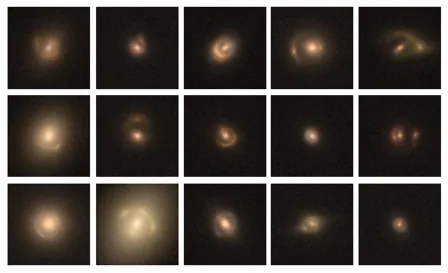
Simon Birrer, associate professor of physics at Stony Brook University, leads the program as principal investigator. Co-principal investigators include Daylan; Xiaosheng Huang, assistant professor of physics at the University of San Francisco; and Justin Pierel, NASA Einstein Fellow at the Space Telescope Science Institute. AstroMusers graduate student Bryce Wedig is a co-investigator and is helping develop the software and measurements that will turn Roman's discoveries into a scientifically useful catalog.
"Strong lenses are rare because galaxies have to be nearly perfectly aligned, one behind the other," Wedig said. "But Roman's resolution and field of view are so great that we expect to find more than 100,000 of these needles in haystacks. I'm thrilled to help build this catalog that will enable a wide range of exciting science."
“Roman is going to transform strong gravitational lensing from a field where we study remarkable systems one at a time into one where we can study them as a population,” Daylan said.
The team will map Roman’s sensitivity to different types of gravitational lenses, enabling astronomers to interpret the unprecedented population Roman will uncover and identify the most promising systems for transformative follow-up studies.
This effort is one of four Roman Cycle 1 General Investigator programs involving WashU researchers selected by NASA for the Roman mission. Roman is scheduled to launch no earlier than August 30.