A WashU-led study offers new insight into how magnetic fields regulate matter falling toward a black hole and how newly created particles may help sustain jets launched near it
Imagine matter spiraling toward a black hole as magnetic fields twist, intensify and erupt around it.
This turbulent environment can produce some of the universe's most dramatic phenomena. Spinning black holes can launch jets of energy and particles into space. Understanding how matter behaves near these objects remains a challenge, particularly when the surrounding plasma is so dilute that its particles rarely collide.

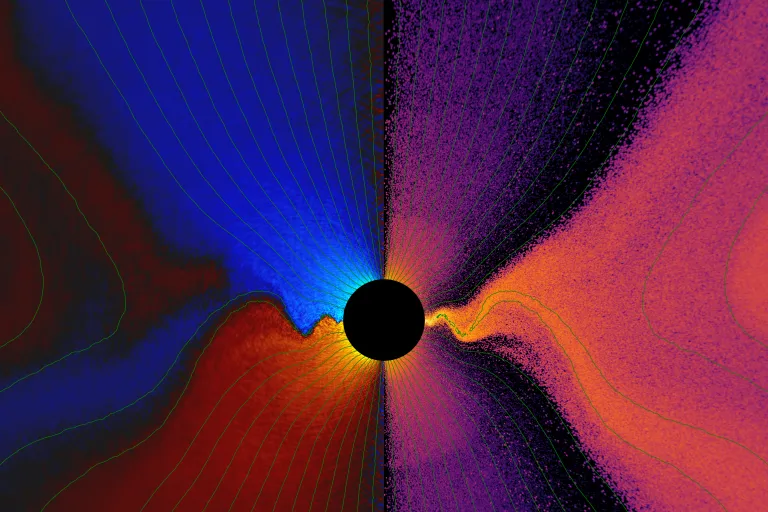
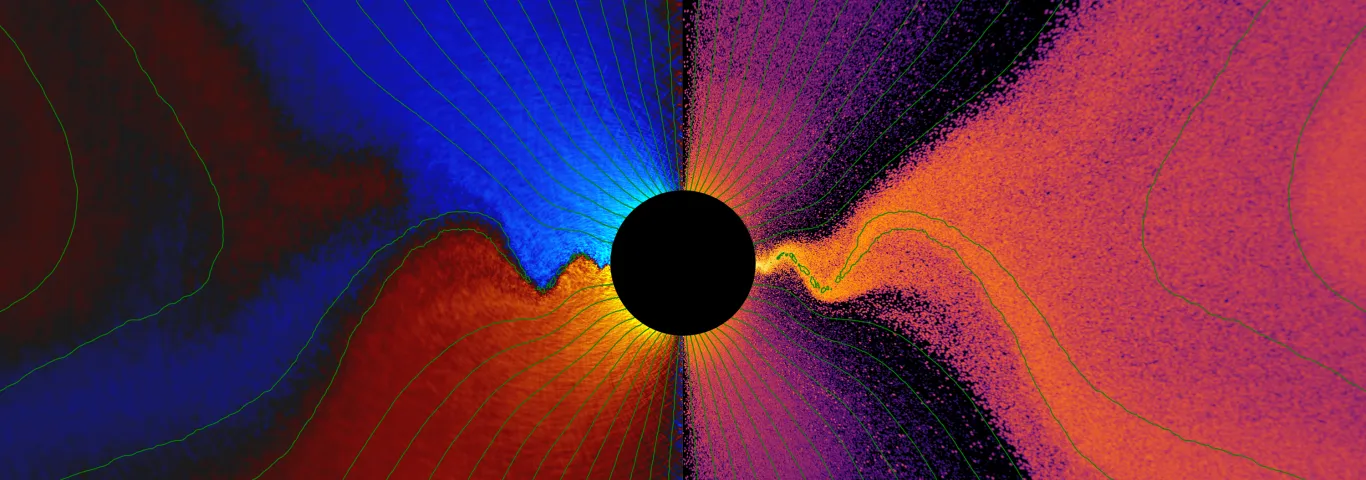
New simulations led by John Mehlhaff, a staff scientist at Washington University in St. Louis, offer a closer look at how matter falls toward a spinning black hole. The study provides the first fully kinetic simulations of black-hole accretion that begin with plasma carrying angular momentum. Published in Physical Review Letters, where it was selected as an Editors’ Suggestion, the study was co-authored by Alex Chen and Yajie Yuan, both assistant professors, and Martin Luepker, who was a graduate student at the time. All four researchers are affiliated with the McDonnell Center for the Space Sciences and the Department of Physics.
The researchers used a kinetic simulation, a computer model that tracks individual charged particles rather than treating plasma as a fluid. This approach allowed them to follow how particles interacted with electromagnetic fields as they moved through the curved spacetime surrounding a rapidly spinning black hole. The simulations showed how magnetic fields help orbiting plasma transfer angular momentum outward, allowing matter to spiral inward toward the black hole.
Magnetic fields shape the flow
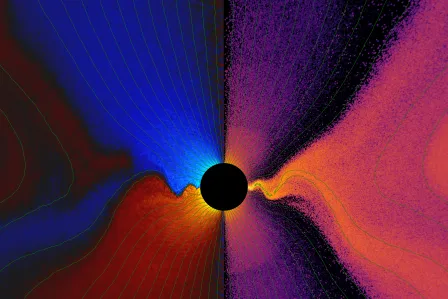
The researchers modeled a rapidly spinning supermassive black hole surrounded by a rotating, ring-shaped cloud of plasma. The setup represents the kind of environment found near supermassive black holes at the centers of galaxies such as the Milky Way and M87. The simulation built on earlier work by Luepker, Yuan and Chen that produced a stable mathematical model of a ring of collisionless plasma orbiting a spinning black hole. That model provided the starting point for the new simulations.
The plasma carried angular momentum, allowing the researchers to investigate how matter begins to spiral toward the black hole. As the plasma rotated and moved inward, turbulence developed and magnetic fields intensified. The fields accumulated around the black hole until they reached a saturation point. The researchers then observed eruptions that expelled some of the accumulated magnetic flux.
This behavior resembles a magnetically arrested disk (MAD), a state previously observed in fluid-based simulations. The similarity suggests that some large-scale features of accretion can emerge even when researchers model the individual particles that make up the plasma.
When particles behave collectively
Although the plasma particles rarely collide, they still interact with electromagnetic fields and can develop instabilities that affect their movement.
The researchers observed two such instabilities, known as the mirror and firehose instabilities. These processes regulate differences in the plasma's pressure in directions parallel and perpendicular to magnetic fields.
In practical terms, the instabilities scatter particles' directions of motion, limiting how different the pressures can become. By regulating these pressure differences, the instabilities help the collisionless plasma behave more like a fluid.
As Mehlhaff explained, “Researchers had long suspected that a collisionless accreting plasma would develop instabilities that provide a kind of effective collisionality, causing it to behave like a collisional fluid. Thanks to these simulations, we got to witness these instabilities unfold for the first time within a global accretion model of a collisionless orbiting plasma.”
How jets get their start
The kinetic approach also allowed the researchers to examine the funnel surrounding the black hole's rotation axis, where powerful jets can form.
The researchers found that plasma from the accretion disk did not efficiently enter this region. Without enough charged particles in the funnel, the process that extracts energy from the spinning black hole and helps power a jet could not operate.
When pair production was included, the simulation generated electron-positron pairs that supplied the funnel with charged particles. The jet-launching process then operated, producing a jet dominated by electromagnetic energy.
The results suggest that newly created particles may be necessary to sustain jets under the conditions modeled in the study.
Looking beyond the simulation
The researchers also found that the jet funnel and the thin current sheet near the equatorial plane were important sites of nonthermal particle acceleration. The accretion flow itself remained largely thermal.
The simulations were two-dimensional and limited in their dynamic range. Future work will extend the modeling to three dimensions and investigate how particles are accelerated, how plasma might enter the jet funnel and which processes dominate angular momentum transport.
By modeling individual particles in a spinning black hole's accretion flow, the study offers new insight into how magnetic fields shape accretion and the conditions that may allow powerful jets to form and persist.
“To us, these simulations are just the tip of the iceberg," said Mehlhaff. "They provide a lens through which we can look at some of the longstanding mysteries facing accretion physics with fresh eyes. We’re excited to see where they lead us in the future.”