New MCSS fellow Trevor GrandPre uses physics to explore life on Earth and the possibility of life beyond it
What can physics tell us about life?
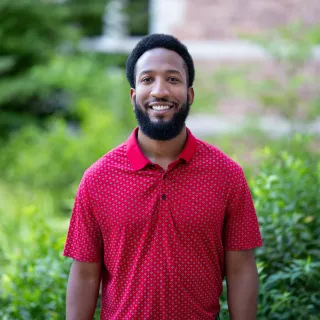
For Trevor GrandPre, the answer spans everything from the microscopic organization of proteins inside cells to the possibility of sustaining life beyond Earth.
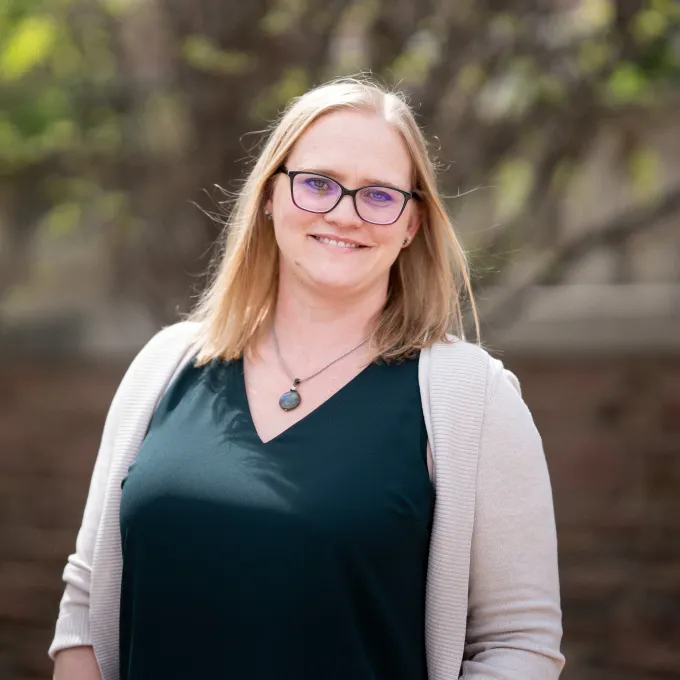
An assistant professor of physics at Washington University in St. Louis and a fellow of the McDonnell Center for the Space Sciences (MCSS), GrandPre studies some of biology's most fundamental questions, including how life organizes itself and maintains order.
GrandPre joined WashU as part of the university's Rules of Life initiative, an interdisciplinary effort that brings together researchers from physics, chemistry, and biology to uncover the fundamental principles that underlie living systems.
The department's growing emphasis on biophysics was one of the factors that attracted GrandPre to WashU.
"Biophysics is one of the four main areas that the department is trying to build up," he said. "They see it as a field of physics, not something that belongs somewhere else."
GrandPre's path to physics reflects that interdisciplinary spirit.
"I've always been interested in biology," GrandPre said. "I actually started out as a biology major in college for the first two years, and then eventually switched to physics."
Although he changed majors, he never lost his interest in living systems. Instead, physics gave him a new way to approach biological questions.
Today, GrandPre uses physics to study how living systems organize themselves. He is particularly interested in how molecules inside cells form specialized structures and how those interactions shape complex biological behaviors.
One of his primary research interests is biomolecular condensates, specialized structures that form when proteins and other molecules gather together inside cells. By studying how these structures form and function, GrandPre hopes to uncover common rules that apply across many biological systems.
"One of my passions is understanding the physics of how these kinds of states form," he said. "Is there some universal understanding that we can apply to all of these cases?"
GrandPre believes that understanding the fundamental principles that govern life on Earth may also help scientists understand how life could exist elsewhere in the universe. That connection between biology and astrobiology is one of the reasons he was drawn to MCSS.
"I'm generally interested in astrobiology," GrandPre said. "That can mean looking for life that already exists elsewhere, or asking how we could support life when humans eventually leave Earth and try to live somewhere else."
One area he hopes to explore involves cyanobacteria, microscopic organisms that convert carbon dioxide into compounds needed for growth and survival. Researchers are investigating whether they could someday help produce food and other resources for long-duration space missions or future habitats beyond Earth.
GrandPre's interdisciplinary research is exactly the kind of work MCSS hopes to foster, said William McKinnon, interim director of the McDonnell Center for the Space Sciences.
"Many of the important scientific advances of the future will come from interdisciplinary work, of which Trevor's is a prime example. The McDonnell Center views the 'space sciences' very broadly, even more so today, because as the saying goes, 'we are all stardust.'"
As an MCSS fellow, GrandPre sees opportunities to connect with planetary scientists, astrobiologists, and other researchers whose work intersects with questions about life's origins, evolution, and potential existence elsewhere in the universe.
"I like being a part of this community and look forward to talking with everyone," he said. "There's always things that can open your mind and help you see new, interesting directions."
Born and raised in Crete, Illinois, GrandPre earned a bachelor's degree in physics from DePaul University and a PhD in physics from UC Berkeley. Before joining WashU, he was a postdoctoral fellow at Princeton University's Center for the Physics of Biological Function and Princeton Center for Theoretical Science. He also served as a Schmidt Science Fellow.
GrandPre was recently named a recipient of Scientific American's inaugural Young Scientist Award, which honors exceptional promise and achievement by an early-career researcher.
Asked what scientific discovery he would most like to witness during his lifetime, GrandPre points to one that would fundamentally reshape humanity's understanding of its place in the cosmos.
"If they find organisms that are still alive now," he said. "It could be bacteria or some other microorganism, but if they find them living, I think that would be very interesting."