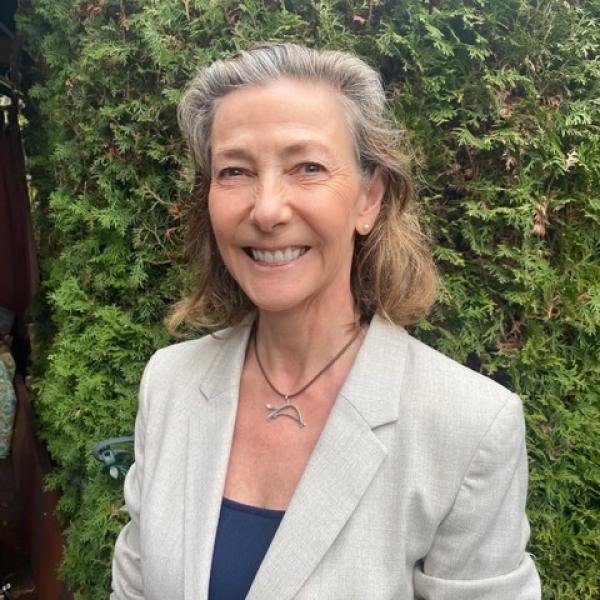
MCSS fellow Chong Zu develops quantum technologies designed to help scientists see, measure and understand phenomena that conventional tools cannot easily capture.
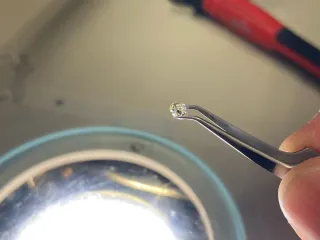
What can a tiny flaw in a diamond tell us about the Moon?
Quite a lot, as it turns out.
A team led by Washington University physicist Chong Zu used a quantum diamond microscope to map the magnetic properties of a small lunar sample returned by the Apollo program. The technique allowed the researchers to measure the sample's magnetization at microscopic scales without damaging the precious rock, revealing clues about the Moon's magnetic history.
For Zu, the lunar experiment illustrates something much bigger than a clever way to study Moon rocks. It demonstrates the potential of quantum sensing to open new avenues of research across disciplines.
"We're trying to make these quantum sensors useful to people outside the field of quantum physics," Zu said. "This is a really cool technology that you can actually try in your research and see whether it can improve upon conventional methods."
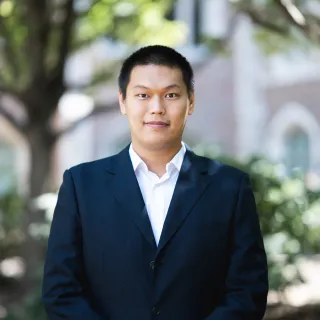
Zu, an assistant professor of physics and a member of the Center for Quantum Leaps, became a fellow of the McDonnell Center for the Space Sciences (MCSS) in 2025. His research uses solid-state quantum systems, including defects in diamond, as extremely sensitive probes of magnetic fields, temperature, stress and other properties.
The idea may sound exotic, but the underlying concept is surprisingly simple. Tiny defects in diamond can serve as extraordinarily sensitive quantum sensors, allowing Zu and his collaborators to detect those properties at very small scales.
From the Moon to Earth's interior
The same approach that Zu used to study the Moon is now being applied to questions about Earth's interior. He is collaborating with MCSS faculty members Michael Krawczynski, associate professor, and Philip Skemer, professor, both in Earth, environmental and planetary sciences, to apply quantum sensing to geomaterials.
One area of this research involves using quantum sensors to measure magnetic fields and stress in materials. Skemer studies materials under extreme pressures to better understand conditions deep inside Earth, and Zu's group is exploring how quantum sensors can make those measurements in such environments.
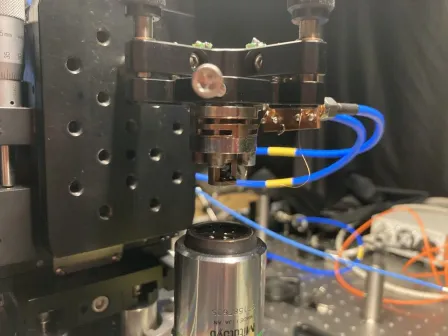
In a diamond anvil cell, two diamond tips squeeze a sample between them, creating enormous pressures. Zu and his colleagues are developing ways to put quantum sensors directly into the diamond tips so they can measure magnetic fields and stress under those extreme conditions.
"The question is, how do you deploy them to different fields?" Zu said.
That question is at the heart of his research.
His group is also exploring quantum-enabled X-ray detectors with MCSS fellow Henric Krawczynski, the Wilfred R. and Ann Lee Konneker Distinguished Professor in Physics. The proposed technology would use an array of quantum sensors to improve the spatial and energy resolution in X-ray telescopes, potentially allowing scientists to distinguish more precisely where X-rays are coming from in the universe.
And in collaboration with researchers at WashU Medicine, Zu is applying quantum sensors to living cells. His group is exploring how the sensors can measure temperature within individual cells, providing a way to investigate the thermodynamics and metabolism of cells.
The variety of applications is intentional.
"I'm a quantum scientist, but I also have a strong focus on applied physics," Zu said.
As an experimentalist, he enjoys developing new ways to improve the performance of quantum sensors. But he also wants those technologies to solve problems beyond his own field.
"I want to do something that isn't only about fundamental physics," he said. "I want it to be useful to other people and other fields, so they can use it to solve their own problems."
A quantum toolkit for scientists
MCSS provides a natural home for Zu's interdisciplinary approach. His research crosses physics, planetary science, materials science, astronomy, and biomedical research, and the center gives him opportunities to connect with scientists asking questions where quantum sensing might make a difference.
"MCSS has over a 50-year history of fostering interdisciplinary research, bringing together instrument builders, experimentalists and theorists across departments," said Michael Nowak, research professor of physics and Associate Director of the McDonnell Center for the Space Sciences. "Chong Zu has been a fantastic addition to this tradition. It has been extremely exciting to see him bring his groundbreaking research to interdepartmental research centers, including the Center for Quantum Leaps."
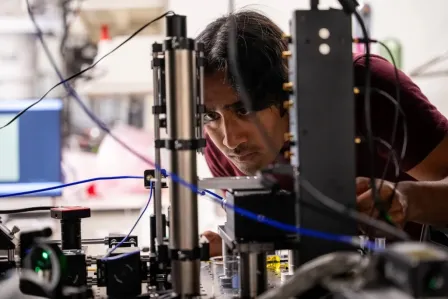
He and his colleagues are working toward establishing a quantum-sensing user facility in the Department of Physics, where researchers could bring their own samples and explore whether quantum sensing could provide measurements that conventional techniques cannot.
The effort builds on WashU's NSF-funded Research Traineeship Linking Quantum Sensing Technologies across Disciplines (NRT LinQ) program, which brings together researchers and students from different fields to learn about quantum sensing. The program's summer boot camp gives participants hands-on experience with quantum diamond microscopy and the opportunity to test their own samples.
Zu sees that kind of openness as essential to the future of quantum sensing.
"We're happy to discuss anything," he said. "We're open to anyone who wants to try quantum sensors."
For scientists in other fields, Zu's invitation is straightforward. Bring a difficult measurement problem and see whether quantum technology can help.
Zu began his graduate studies in quantum computing, a field he expected could revolutionize technology. Over time, however, he became increasingly interested in quantum sensing, where he saw opportunities to put quantum technology to work in the real world.
"I switched to quantum sensing because I believe it is a more mature way of applying quantum information technology," he said. "We're already starting to make an impact in many different fields."
Now he is interested in finding the places where that impact could be greatest.
At the most fundamental level, Zu is excited about using quantum entanglement to improve the performance of his sensors. But he is equally interested in finding scientific problems in other disciplines where quantum sensing could make a significant difference.
"We want to find the right applications and the really big scientific problems in other disciplines where conventional spectroscopy tools are the bottleneck and our sensors can step in and make a giant leap forward," he said.
For Zu, the future of quantum sensing may therefore be found not only in better quantum technology, but in the scientists who discover what to do with it.
The next important application could be somewhere in a Moon rock, deep inside a material under immense pressure, inside a living cell or at the far reaches of the universe.
The question is simply where to look.
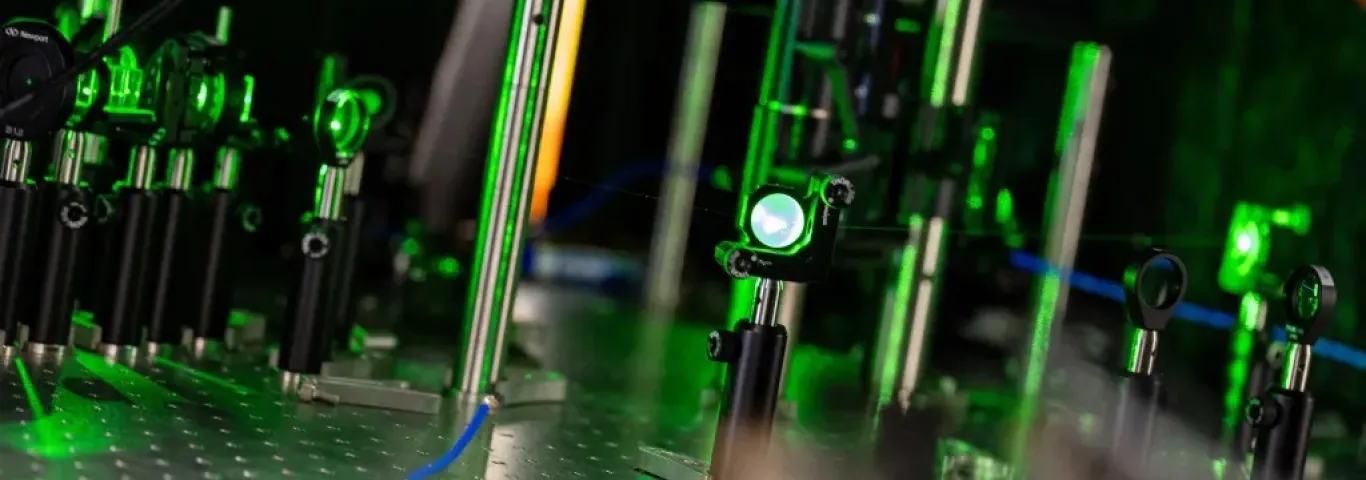
Header image: WashU's quantum diamond microscope features nanodiamonds modified by scientists to be extremely sensitive to outside forces. (Sean Garcia/WashU)