Meteorites preserve clues to the earliest days of the solar system. Cosmochemist Thorsten Kleine will explore how these ancient rocks reveal the origins of Earth, the Moon, and the conditions that made our planet habitable.
Earth is home to life, oceans, and an atmosphere that sustains us. But how did our planet become the world we know today? The answer reaches back more than 4.5 billion years, to a time when the solar system was taking shape and dust and gas orbiting the young Sun were beginning to form planets.
Some of the most revealing clues to that ancient history are found in meteorites, fragments of extraterrestrial material that survive passage through Earth's atmosphere to reach the ground. These rocks preserve evidence of the materials and processes involved in planet formation, offering scientists a way to investigate how Earth formed and what made it habitable.

Thorsten Kleine, a world-leading cosmochemist, studies our planetary origins through precise isotope measurements. He is the director of the Max Planck Institute for Solar System Research and a scientific member of the Max Planck Society in Germany.
His research addresses fundamental questions about our planetary origins, including where the material that built Earth came from, how dust and rocky bodies combined to form a planet, and what meteorites can reveal about the giant impact that formed the Moon.
Kleine investigates these questions by analyzing isotopic differences in meteorites and planetary materials. Isotopes are different forms of the same element, with the same number of protons but different numbers of neutrons. The early solar system contained material created by earlier generations of stars, and that material was not completely mixed as the Sun and planets formed. As a result, different planetary building blocks retained distinct isotopic signatures.
Recent research involving Kleine has shed new light on the origins of meteorites. Using isotope measurements, researchers found that meteorites derive from parent bodies that formed in two distinct regions of the solar system, most likely just inside and outside Jupiter's orbit. Earth and the other terrestrial planets formed mostly from material originating in the inner solar system, although contributions from the outer solar system likely helped deliver volatile elements, including water, to Earth. These findings help explain the diverse compositions of planetary building blocks and offer new insight into how Earth formed.
"Studying meteorites is exciting because they provide the only rocky record of our origins and allow us to understand how the formation of Jupiter shaped the early solar system and the formation of Earth," Kleine says.
"The work by Dr. Kleine and his group and collaborators has been pivotal in the discovery and elucidation of what we now call the Great Isotopic Dichotomy," says William McKinnon, Clark Way Harrison Distinguished Professor in the Department of Earth, Environmental, and Planetary Sciences and director of the McDonnell Center for the Space Sciences. "This is arguably the greatest discovery in cosmochemistry in recent years. Through it we have been able to link the formation of the Earth to the birth of stars and planets in our galaxy generally. And it is an arena of research that continues to expand, as we will hear in his two talks."
One of the most intriguing puzzles involves the relationship between Earth and the Moon. According to the leading giant-impact model, the Moon formed from debris produced when a Mars-sized body collided with the young Earth. Scientists initially expected this scenario to produce measurable differences in the isotopic compositions of Earth and the Moon, reflecting the material contributed by the impacting body.
Instead, analyses of lunar samples have revealed striking similarities between the isotopic compositions of Earth and the Moon. These similarities have prompted scientists to refine models of the giant impact, examining how thoroughly material from the two bodies mixed and how the Moon formed from the resulting debris. By comparing isotopic signatures in lunar samples, meteorites, and Earth rocks, Kleine and other researchers can test these models.
“Thorsten has made many original and important contributions to our understanding of the early solar system. His work has helped us determine when key events occurred during planetary formation and understand the composition and structure of the protoplanetary disk. Many of his discoveries have been truly paradigm-shifting, changing how we think about how planets form and evolve,” says Kun Wang, associate professor of Earth, environmental and planetary sciences.
Kleine became director of the Max Planck Institute for Solar System Research in 2022 and leads the Planetary Science Department there in Göttingen, Germany. Previously, he was a professor of planetary science at the University of Münster and an assistant professor at ETH Zürich. His honors include the F. W. Clarke Medal of the Geochemical Society, the Nier Prize of the Meteoritical Society, and the Victor Moritz Goldschmidt Prize of the German Mineralogical Society. In 2023, he was named a Geochemistry Fellow by the Geochemical Society and the European Association of Geochemistry for his contributions to understanding the formation and early evolution of the solar system.
Kleine will deliver the 2026 Robert M. Walker Distinguished Lectures at Washington University in St. Louis on November 18 and 19. His scientific colloquium, "Meteorites and the Origin of the Earth and Moon," will explore what meteorites reveal about the formation of our planet and its satellite. His public lecture, "Meteorites – Time Capsules of the Solar System or How to Form a Habitable Earth," will explore how these ancient rocks help scientists understand Earth's origins and the conditions that made it habitable.
2026 Walker Distinguished Lectures
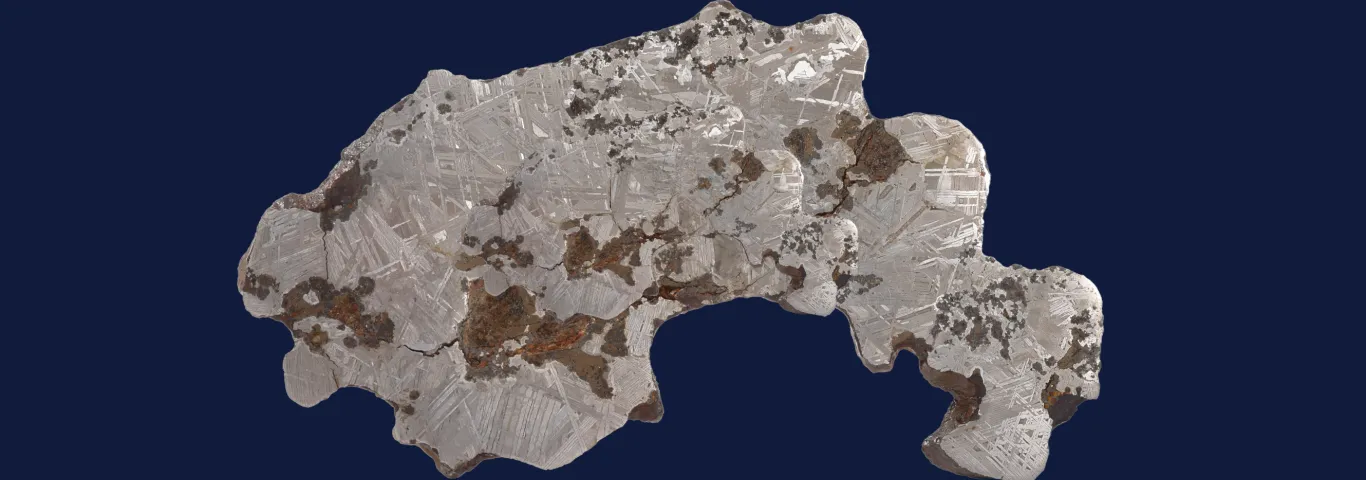
Header image: The Maltahöhe meteorite, found in Namibia in 1991, is a 22.27-kilogram iron meteorite containing small silicate inclusions. (Credit: MPS/T. Klawunn)