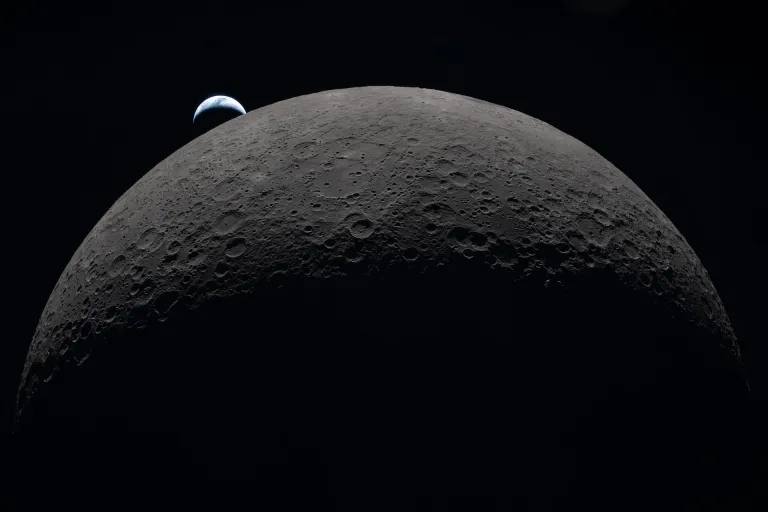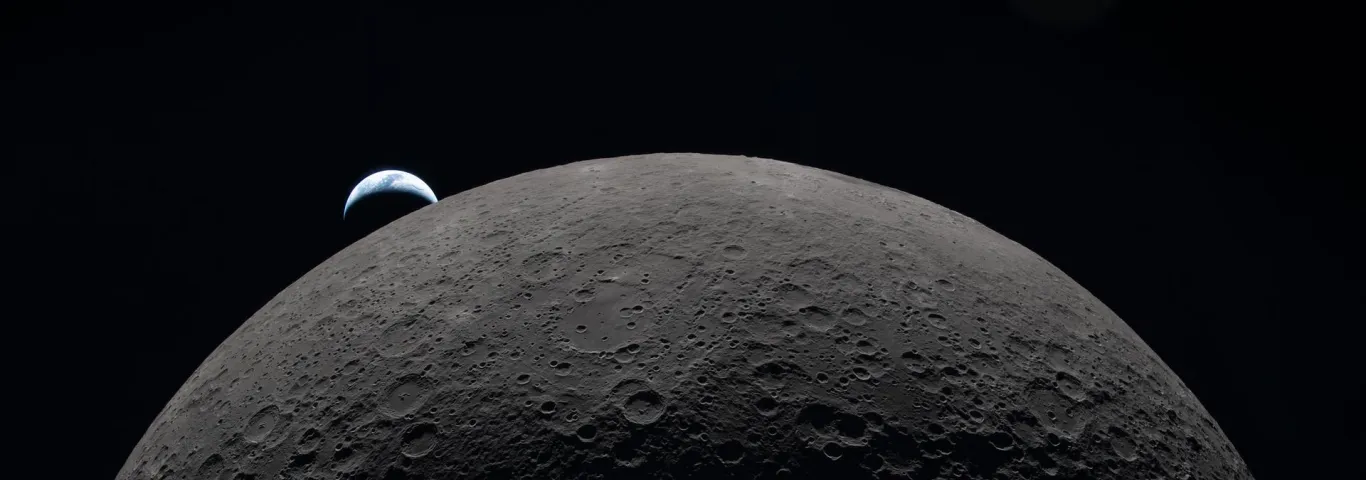
WashU's lunar science legacy spans more than five decades, from analyzing Apollo samples to helping identify priorities for future human exploration.
The National Academies of Sciences, Engineering, and Medicine recently published its consensus report, Human Exploration Across the Moon, identifying four high-priority science destinations beyond the lunar south pole for future human exploration.
William McKinnon, the Clark Way Harrison Distinguished Professor in Earth, Environmental, and Planetary Sciences in Arts & Sciences and director of the McDonnell Center for the Space Sciences (MCSS), served on the Lunar and Planetary Panel, which contributed to the Steering Committee's recommendations. The four sites are the Bhabha Crater (on the lunar farside), Mons Hadley (the Apollo 15 landing site), the Orientale Basin (the last of the great multiringed impact basins to form on the Moon), and the Aristarchus Plateau (a much younger volcanic region on the nearside). Exploring these locations would allow astronauts to investigate important scientific questions across multiple disciplines, including not just lunar science, but astronomy and astrophysics, heliophysics, and biology and human physiology, all while advancing understanding of how humans might one day live and thrive on the Moon, according to the report.
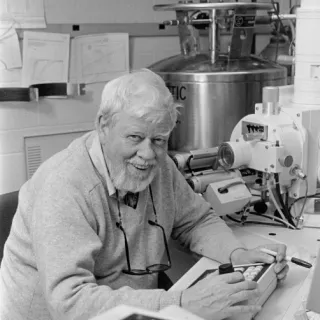
WashU's involvement in lunar science dates to the Apollo era. Physicist Robert M. Walker, who arrived at the university in 1966, developed techniques to reveal nuclear particle tracks in minerals and glasses, using them to investigate the effects of cosmic radiation on lunar materials. In 1969, his expertise helped secure one of the first allocations of samples returned by Apollo 11. Walker also joined three other scientists, known as the "Four Horsemen," who played a major role in establishing the Lunar Receiving Laboratory at Johnson Space Center, where the Apollo samples were initially processed and studied.
The McDonnell Center was established in 1974, providing a lasting foundation for research in the space sciences. Walker's laboratory continued to push scientific boundaries, using an ion probe to analyze presolar grains, tiny particles of stardust preserved in meteorites.
Another major chapter in WashU's lunar science history began in 1976, when geochemist Larry Haskin joined the university to lead the newly reorganized Department of Earth and Planetary Sciences. Already one of the early NASA-funded researchers studying Apollo samples, Haskin brought his lunar sample allocation and researchers Randy Korotev, Marilyn Lindstrom and Dave Lindstrom to WashU. Korotev ran the laboratory for instrumental neutron activation analysis (INAA) for over 40 years, analyzing thousands of samples to determine the chemical composition of lunar materials.
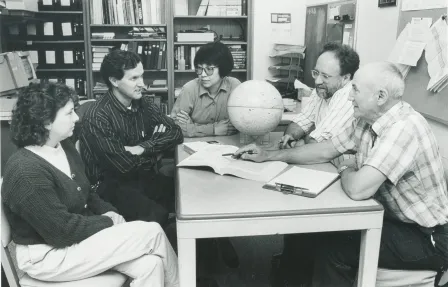
Their work extended beyond the Apollo collection. Korotev became a leading researcher on lunar meteorites, including specimens recovered during Antarctic expeditions. Haskin's research also looked ahead to future exploration, examining how oxygen and useful metals could be extracted from lunar soil for use in space.
The next generation of WashU lunar scientists built on this foundation. Brad Jolliff, Scott Rudolph Professor Emeritus of Earth, Environmental, and Planetary Sciences and former director of MCSS, worked closely with Haskin and Korotev. He later expanded lunar research by integrating sample analyses with data from NASA's Clementine and Lunar Prospector missions. That work contributed to New Views of the Moon, an influential synthesis of lunar science. Jolliff has also served on the science team for the Lunar Reconnaissance Orbiter Camera instrument since the mission launched in 2009.
Jeffrey Gillis, a research professor of physics, also conducted lunar research in Haskin's group, first as a postdoctoral researcher and later as a research scientist, combining remote-sensing observations with information from lunar samples. After nearly two decades at the University of Hawaii, Gillis returned to WashU, bringing a node of NASA's Solar System Exploration Research Virtual Institute (SSERVI). The Interdisciplinary Consortium for Evaluating Volatile Origins brought together researchers from WashU and other institutions to study how space weathering affects the lunar surface, with particular attention to volatile elements.
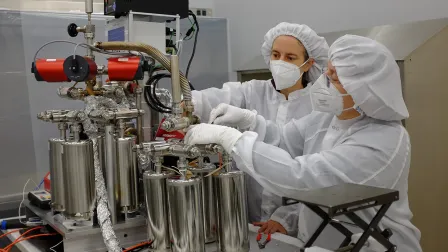
Decades later, WashU scientists continued that work through NASA's Apollo Next Generation Sample Analysis program. A team led by Jolliff joined an international consortium studying a previously unopened Apollo 17 lunar core, while other WashU researchers developed specialized equipment to extract gases from the sealed sample container. The broader WashU effort involved researchers across several disciplines, including geochemistry, isotope analysis and planetary science. Kun Wang and Rita Parai, both associate professors of Earth, Environmental, and Planetary Sciences, continue investigations of lunar sample geochemistry and isotopic composition with their students, building on work begun by earlier generations of WashU researchers.
Jolliff's work now extends to NASA's Artemis program. He is a member of NASA's Artemis landed geology team, which will help identify and recommend scientifically valuable sites for future Artemis lunar landings. McKinnon's work with the National Academies panel similarly connects the university to the scientific priorities that will guide future human exploration.
From the first Apollo samples to the next generation of lunar missions, WashU researchers have helped expand understanding of the Moon and prepare for what comes next. As NASA and its partners look toward renewed human exploration, the university's work in lunar science continues, building on a legacy of discovery while helping shape the questions and priorities of future missions.
McKinnon notes, “The McDonnell Center for the Space Sciences was founded in the heat of the Apollo era. A new age of lunar exploration is dawning, and WashU and McDonnell Center researchers will continue to play leading roles.”