
Halley's Spectacular 2061 Prospects: St. Louis Astronomical Society June Meeting
Joseph Marcus, former editor of Comet News Service, will be presenting "Halley's Spectacular 2061 Prospects" at the St. Louis Astronomical Society's June meeting
Dr. Joseph N. Marcus will recount his tumultuous experience with Halley’s Comet while editing Comet News Service for the McDonnell Planetarium between 1975 and 1986. To forecast its brightness in 1985-86, analysts had to draw on the visual magnitude reports from the 1909-10 apparition. Dr. Marcus will explain comet brightness behavior, how brightness is estimated visually, and why expert predictions were so inaccurate in 1986. He will also review Halley’s Jekyll-Hyde personality through history. Why was it “big or bright” as the full Moon in 1066, and visible in daylight in 1222 and just off the limb of the Sun in 1910, but so unimpressive in 1985-86? The explanation involves the bizarre way microscopic comet dust scatters sunlight preferentially in a forward direction. Failure again to account for this special physics in conventional forecasts will underestimate the comet’s peak brightness by 8-fold in the summer of 2061. Dr. Marcus predicts that Halley’s brightness-enhanced head will rival Jupiter in brilliance, and with its similarly-enhanced dust tail added in, the comet might even briefly cast shadows.
Marcus is a retired pathologist, SLAS member, former editor of Comet News Service, and comet researcher and writer. He serves on the Advisory Board of Lowell Observatory.
The St. Louis Astronomical Society is an organization for individuals interested in astronomy and telescopes. The public is invited to attend its meetings, telescope observing sessions, and special events. For more information about Astronomical Society events, please visit www.slasonline.org.
Free parking will be available.
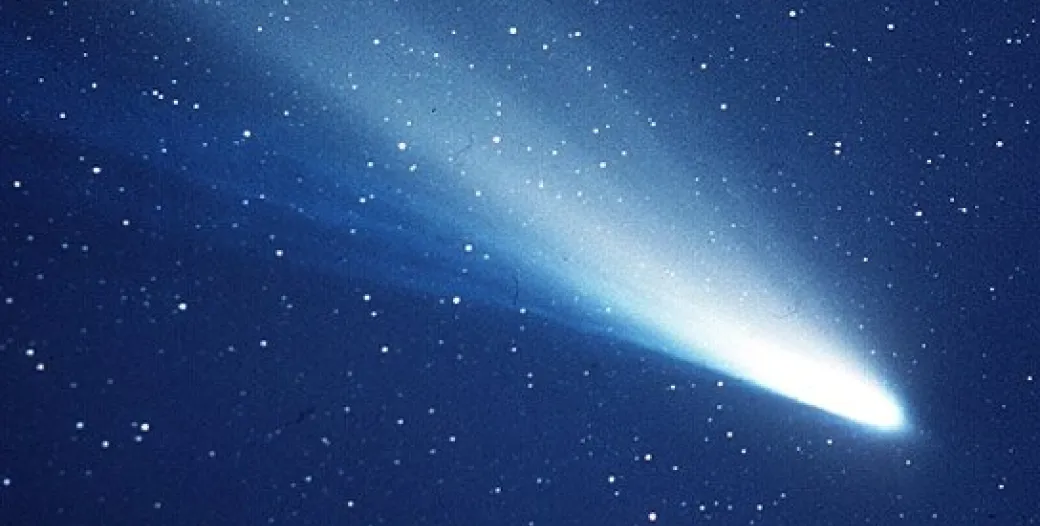
Header image: Halley's comet (Credit: NASA Jet Propulsion Laboratory, California Institute of Technology)